
- January and December Overlap
- Fasting Hours Set to Change
- A Rare Calendar Convergence
Article Today, Hyderabad:
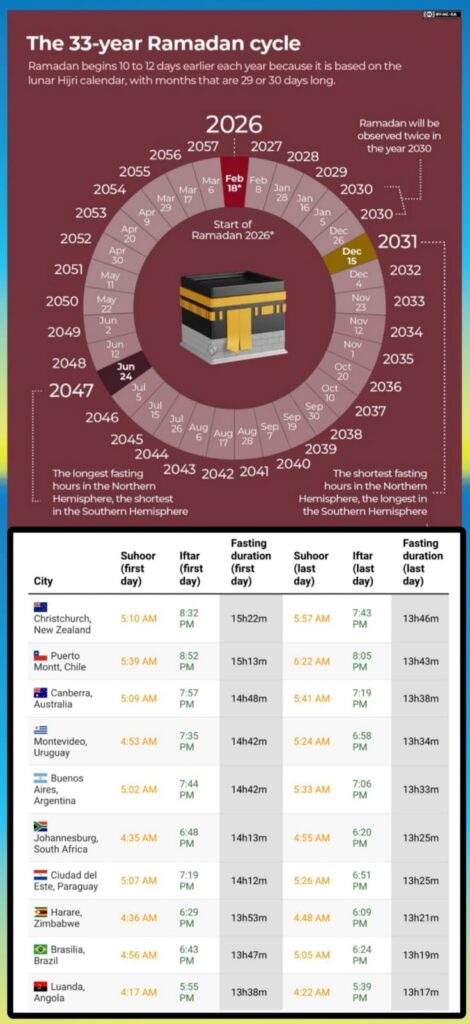
The year 2030 will witness an uncommon astronomical alignment. Muslims across the world are expected to observe Ramadan twice within the same Gregorian year. The first is projected to begin around January 5. The second is likely to commence around December 26. This rare occurrence happens roughly once every 33 years due to structural differences between lunar and solar calendars.
Moving Through The Seasons
Ramadan has been steadily shifting across seasons. In recent years, it has moved from peak summer in many northern hemisphere countries toward cooler months. By 2031, Ramadan is expected to coincide with the winter solstice period in the northern hemisphere, when daylight hours are shortest. As a result, fasting durations will gradually decrease in countries located above the equator.
Why It Happens
The Islamic Hijri calendar follows the lunar cycle. Each lunar year lasts about 354 days. In contrast, the Gregorian calendar follows the solar year of approximately 365 days. The 11-day gap causes Islamic months to move earlier each year. Over time, this shift allows Ramadan to appear twice within one Gregorian year. Astronomers describe this as a predictable mathematical progression rather than a sudden anomaly.
Unequal Fasting Hours
However, the impact differs across regions. Around 90 percent of the global Muslim population lives in the northern hemisphere. There, fasting hours during the upcoming cycles are expected to range between 12 and 13 hours in many regions. Meanwhile, countries in the southern hemisphere, including Chile and New Zealand, will experience longer daylight hours during their summer season. In some areas, fasting may extend to 14 or 15 hours. Geography continues to shape daily religious practice.
Faith Beyond Timekeeping
Ramadan marks the month when the Quran was first revealed to Prophet Muhammad over 1,400 years ago. From dawn until sunset, Muslims abstain from food and drink. The fast is intended to cultivate discipline, self-restraint and spiritual awareness, often referred to as taqwa. The month lasts 29 or 30 days, depending on moon sightings. It concludes with Eid al-Fitr.
A Predictable Yet Rare Event
Astronomers and religious scholars note that the 2030 phenomenon is neither symbolic nor unprecedented. It is a natural outcome of calendar systems that measure time differently. Nevertheless, for believers, observing two Ramadans within a single Gregorian year remains spiritually significant. The lunar cycle continues its course. Human calendars adjust around it.